top of page

The Master Matrix: Loan Against Securities LTV Parameters
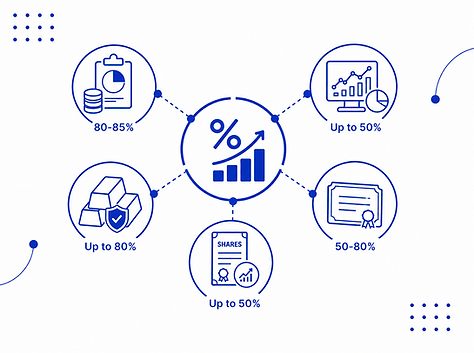
In asset-backed debt engineering, the Loan-to-Value (LTV) percentage is the critical metric that determines your exact liquidity runway. Every financial instrument carries an inherent market risk profile, which institutional underwriters manage by applying a specific "haircut" to your portfolio value. Understanding your loan against securities LTV framework allows corporate treasuries and promoters to optimize asset allocation and maximize non-dilutive capital extraction.
%20Pageb%202.png)
Managing Margin Calls and Market Volatility
Because secondary market securities experience real-time price fluctuations, your portfolio value is monitored continuously. If a sharp market correction occurs, causing your active loan balance to exceed the authorized loan against securities LTV threshold, a margin call protocol is initiated.
-
LTV Restoration Window: Borrowers are provided a predefined timeline to restore equilibrium.
-
Remediation Pathways: Balance restoration can be accomplished either by infusing immediate cash to reduce the drawn debt or by pledging additional approved scripts to cushion the collateral pool.
-
Lien Release Mechanics: Conversely, as your primary market assets appreciate or debt is paid down, proportional blocks of your portfolio are systematically un-pledged and released from the depository lien.
To stress-test your current corporate holding sheet against these exact metrics, submit your demat statement to our advisory desk at loanagainstsecurities.co for an automated valuation.
Technical LTV Breakdown Across Eligible Securities
LTV calculations are dynamic and depend on asset liquidity and regulatory guidelines. Below is the definitive, structured LTV matrix mapping out both general institutional ceilings
Asset Class / Collateral Type | Peak Portal Ceiling | Indicative Terms |
|---|---|---|
Large-Cap Listed Shares | Up to 65% | 45% (Varies based on scripts) |
Mid-Cap Listed Shares | Up to 50% | 35% (Varies based on scripts) |
Equity Mutual Funds | 50% to 60% | 50% |
Debt Mutual Funds | 75% to 85% | 70% |
Corporate Bonds | Up to 80% | 65% |
Government Bonds / G-Secs | Up to 85% | 80% |
Bank Fixed Deposits (FD) | Up to 95% | 80% |
Sovereign Gold Bonds (SGB) | Up to 85% | 65% |
bottom of page